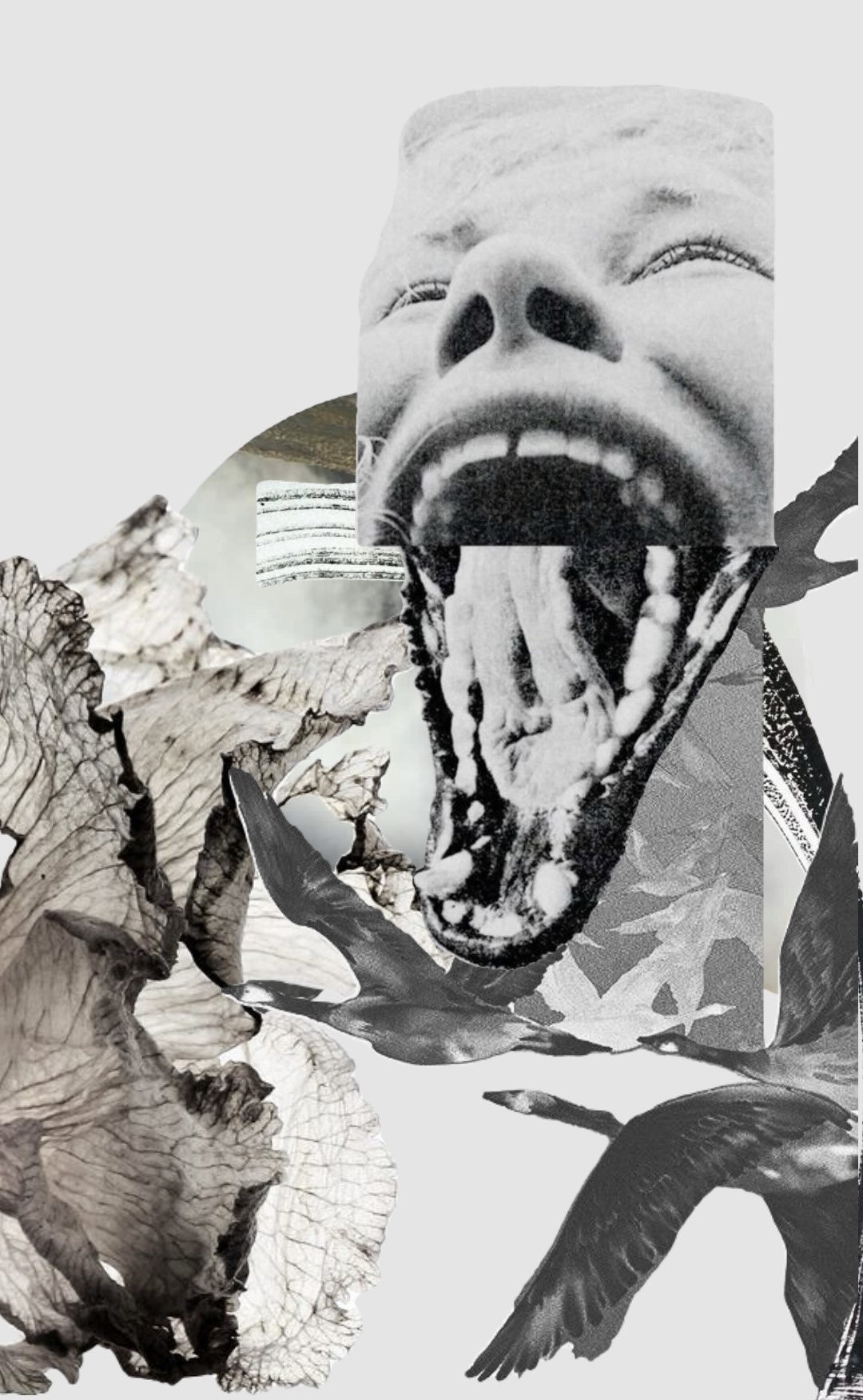
When someone hurts you, Don’t hold it in your body Or let it leak like acid Through your veins. Take something tender
Go to a high place, The suicide bridge with The fence that prevents people Making permanent decisions. Look down
When you push the sun over the edge And hear the great silence as it falls Though it’s milliseconds, a rotation As long as a life, and the burst Concrete, flesh splitting
The seed that wriggled in you Released, a splatter. After all Your enemy is dying too, With any luck—faster than you.
Artist Statement: These photographs were all taken in my historic neighborhood in downtown Evansville, IN. The images capture the character of the buildings and homes and also suggest the need for continued attention and revitalization.
Kristin LaFollette is a writer, artist, and photographer and is the author of the chapbook, Body Parts (GFT Press, 2018). She is a professor at the University of Southern Indiana and serves as the Art Editor at Mud Season Review. You can visit her on Twitter at @k_lafollette03 or on her website at kristinlafollette.com.
Jacalyn den Haan is an emerging writer from Canada’s west coast and currently located in Montreal, Canada. Her work has appeared in Blank Spaces, Savant-Garde, and EVENT magazines. Her poetry chapbook Selected Leavings is forthcoming with Cactus Press in 2021.
Once upon a time, there was a girl, the prettiest who was ever seen. One day her mother asked her to bring some cakes to her grandmother who lived in the woods. On her way, she met a wolf. He was handsome and charming and offered to play a game. Let’s race to see who gets to Granny’s first, he said. The wolf arrived first, of course. He swallowed Granny whole and when the girl knocked on her grandmother’s door, the wolf opened it. I win, he said. Then he swallowed her too.
Real Life
She didn’t meet the wolf in the woods, but inside of her house. Her bedroom, in fact. He wasn’t charming or handsome or even a stranger. He was Mr. Stephens, her father’s best friend. He visited at night when her father had passed out on the couch, crumpled beer cans dripping on the floor, leaving stains that would never come out. The wolf pressed the girl against the mattress, his knee in between her ribs. Don’t say a word, he warned.
Victim
She said a word, many of them in fact, to her parents, but they didn’t believe her. Rick wouldn’t do that, her father said. Are you sure it was him, honey? her mother asked. She avoided her daughter’s eyes, pretended the purple bruises, resembling claw marks, on her daughter’s thighs were invisible.
Wolf
I never touched her, he said. She’s the same age as my daughter, Elizabeth. I would never hurt a little girl.
Hero
It happened more than once, the girl told the police. She had snuck out of school and walked to the precinct without anyone knowing. Certainly not her parents, who would never believe her. I have proof, she said. She pulled out her phone and pressed play. It wasn’t hard to get him to confess on tape, his hunger for her was never satiated, he wanted to relive her devouring again and again.
After, when the wolf knew he was boxed in, when he knew he was no longer the predator in the woods, but prey, he said the girl asked for it, with her red cheerleader costume. He could say what he wanted, the girl thought. He wouldn’t get the chance to hunt girls anymore, where he was. And that was the only ending she cared about.
The Box
I talk about it in therapy. Say I’m going to call later that day. Just to check-in on her.
At home, I discard my sneakers with a pull and a flick by the door. My husband sits in his favorite chair, a procedural on the TV, his eyes on his phone. In Josie’s final days, the three of us sat on the couch, our eyes misty as episode after episode aired until the streaming service asked if we were still watching. Her tail thumped softly when we scratched her ears or said her name, a soft echo of our once rambunctious girl. We clicked yes, the TV show humming in the background of our grief.
I say hi to Aaron; he continues to stare at his phone. I wonder if he even realizes the TV is on or if he registers I’m here. Often these days I think we’re just ghosts to one another, our words and our presence white noise.
I walk past him to the kitchen and grab the kettle. I hear my husband speak, the low baritone of his voice, yet I can’t make out the words. I wait to see if he’ll repeat himself. When he does, I squeeze my eyes closed to listen.
How was your session? he asks.
The teakettle whistles. I let that be my answer.
My husband accepts the silence, doesn’t ask if I talked about Josie in therapy. I appreciate this, yet I don’t verbalize it. I know Aaron doesn’t want to pry. We have been cautious around one another since, in a slow, silent waltz around one another’s grief.
Tea in hand, I walk into the living room and station myself before my husband. I bring it up, telling him what I said to my therapist earlier. Just to check-in.
We got the call thirty minutes ago, my husband says. I didn’t want to tell you until you got home. His forehead is deeply lined, ridges of worry and sadness deepening each day. Aaron’s only thirty-five, yet today he appears ancient.
When? I say.
We can go now if you want.
Again, he tiptoes around it. Around me.
How about after our errands? I don’t want her to sit in the car, I say. Josie hated the car.
Aaron agrees. I grasp his hand and squeeze lightly. I hope this tells him what I can’t communicate verbally, that I love him and we’re in this together. That maybe someday soon we won’t be ghosts anymore.
I wait in the car while my husband goes inside. There is no on-street parking so I pull up next to a graffitied fire hydrant and press on the four-ways. I try not to think about him coming back with Josie in a box, her body reduced to ashes. From the brochure, Aaron and I chose a rich mahogany box with a brass nameplate. I’ve seen photos of its glossy redness. Its compactness. But I can’t picture Josie, who used to jump on us, coating our skin in sandpaper kisses, that small and still.
The car beeps when my husband opens the door. He settles into the passenger’s seat, limbs heavy. In his lap, he clutches the box. It looks just like the picture from the brochure except for the nameplate that mocks any attempt at denial. Its engraved brass shouts Josie is dead.
I allow myself one glance at it, and one moment to remember her little body breathing and then not in our arms. Her golden-brown eyes open, staring forward. Her paws slick with my husband and my tears.
How was that only two weeks ago?
I wait for the sound of her tail thumping in the backseat. Or her whine at the car not moving. I turn to my husband; his fingers grip the box so tightly his knuckles are bloodless. He stares forward, at the parked cars ahead. I follow his gaze; watch people get in and out of cars, walk down the street, talk on their cellphones as though it’s just another day. As though today isn’t a funeral.
I shift the car into drive, leaving the flashers, and together again, the three of us drive home.
Christina Rosso is a writer and bookstore owner living in South Philadelphia with her bearded husband and rescue pup. She is the author of SHE IS A BEAST (APEP Publications, 2020), a chapbook of feminist fairy tales. Her first full-length collection CREOLE CONJURE is forthcoming from Maudlin House. Her writing has been nominated for Best of the Net and the Pushcart Prize. For more information, visit http://christina-rosso.com or find her on Twitter @Rosso_Christina.
BERNARD PEARSON: His work appears in many publications, including; AestheticaMagazine , The Edinburgh Review,Crossways, The Gentian, Nymphs The Poetry Village, Beneath The Fever, The Beach Hut The Littlestone Journal. In 2017 a selection of his poetry ‘In Free Fall’ was published by Leaf by Leaf Press. In 2019 he won second prize in The Aurora Prize for Writing for his poem Manor Farm. He is also a Biographer and Prize winning short story writer
Love me back—and if you can’t, then say so, and let me go with whatever peace I can salvage.
Assia Wevill, “Ted Hughes, March 1968,”
She did not sign the letter but, at the bottom of the page she drew a dying bird, with outspread wings,
looking like a woman who had jumped from a roof and was flattened on the ground.
Yehuda Koren & Eilat Negev, from A Lover of Unreason
I am loveless without you. I am loveless in beauty and breath; the midnight perfume of flowers—
blood on blood, with roses and more roses,
eating the red / heart, whole.
. . . A sweetness in your absence / remnants of romance; tulips and their terrors.
—Without you, love, my love,
a blood-longing remains.
. . .
I am flowerlike.
I am alone in my claret silks.
. . .
I dance myself rose-struck. I dance for hours, inside the suicidal-red,
I dance—
with blood,
with a kiss / my love-scar— my love, inside a locket.
And roses, the heart’s last gouts,
Catastrophic, arterial, doomed.
Ted Hughes, from Birthday Letters; “Red,”
for K. D.
A red rose, pressed with perfume of blood / love . . .
Roses that drip from my body to your body, my love, my love,
As deep as the dark—
your blood to my blood,
again, and again as blood-kisses.
I see the suicidal red—
and I see love.
Effy Winter is an American poet and scholar specializing in literary studies with a concentration on the lives and work of German writer Assia Wevill and English poet Ted Hughes. A nominee for The 2018 Pushcart Prize, her poetry has appeared in numerous publications. In 2022, she began pursuing her academic work in England, dividing her time between London and West Yorkshire where she studies confessional poetry at The Ted Hughes Arvon Centre for Creative Writing.
Yusuf Akman was born in Denizli, Turkey. They are a senior philosophy student at Boğaziçi University whose literary focus revolves around what having a queer identity in Turkey is like. Their works appeared in the online journals Trampset, Raised Brow Press, Resurrection Magazine and Cypress Press. Twitter: @Akman_Yusuf_
INTRO: these untitled pieces are from an in-progress but almost finished chapbook called “marbling,” which happens to be about absolutely fucking soul-crushing sorrow.
the gray days are the most difficult; the days when nothing really feels real – least of all you. it’s a different kind of quiet, a different kind of cold and both of them, piercing. time feels viscous, it’s hard to move through so you stay in bed most of the day to save your energy, your strength. lotta gray days ahead, you know. winter again.
december’s breath on the back of your
neck and you, baby born in a blizzard.
time feels viscous
in sixth grade they took you out of
science class and made you talk to the
psychiatrist at school-based youth
services because you related too much
to the worn-down rock faces in the erosion unit. you started crying quietly and couldn’t seem to stop yourself.
but it wasn’t just canyons, plateaus. a worn spot of paint on something touched frequently always hurt too.
Dani Tauber is a basket-case poet, professional ghost, former music journalist, and antiques archivist from NJ. She shares a room with more than 50 journals and several antique locks of hair. She doesn’t know what she’s mourning yet, but she’s beyond consolation.
Kevin Danahy has been writing poems to amuse himself for years; this year he wants to share some poems with others. He lives in Burlington VT. Twitter: @kbdanahy
Fuck time zones and fuck what hour or day it is the question should always be is the sun or moon up where you are? the answer will always be yes
An addendum: fuck the clock
Patti Smith wore it first, look it up. On Instagram she’s always posting pictures of her handwriting or coffee or the moon and honestly? Same
I am trying to find meaning after watching a video of air being moved around, that’s putting it lightly, of fire, of an explosion. I am trying to find meaning after waking up at the dark pre sunrise hour and looking into the horizon and seeing another fire burning here.
The fire there is unlike the fire here but they are both the same in that they remind me of chaos theory or more specifically the butterfly effect.
Homero Gómez González, patron saint of butterflies was murdered this year. This year that has murdered so many in a different time zone than mine. In my time zone people create native plant gardens for butterflies to call home or suburban lawns for no one.
Alexandra Martinez is a baker and poet living in the tumbleweeds of Southern California. You can find her on Instagram @alxndramartinez or twitter @mexicanpiggybnk.
res·ur·rec·tion
/ˌrezəˈrekSH(ə)n/
the action or fact of resurrecting or being resurrected