• Seizure by Jason M. Thornberry

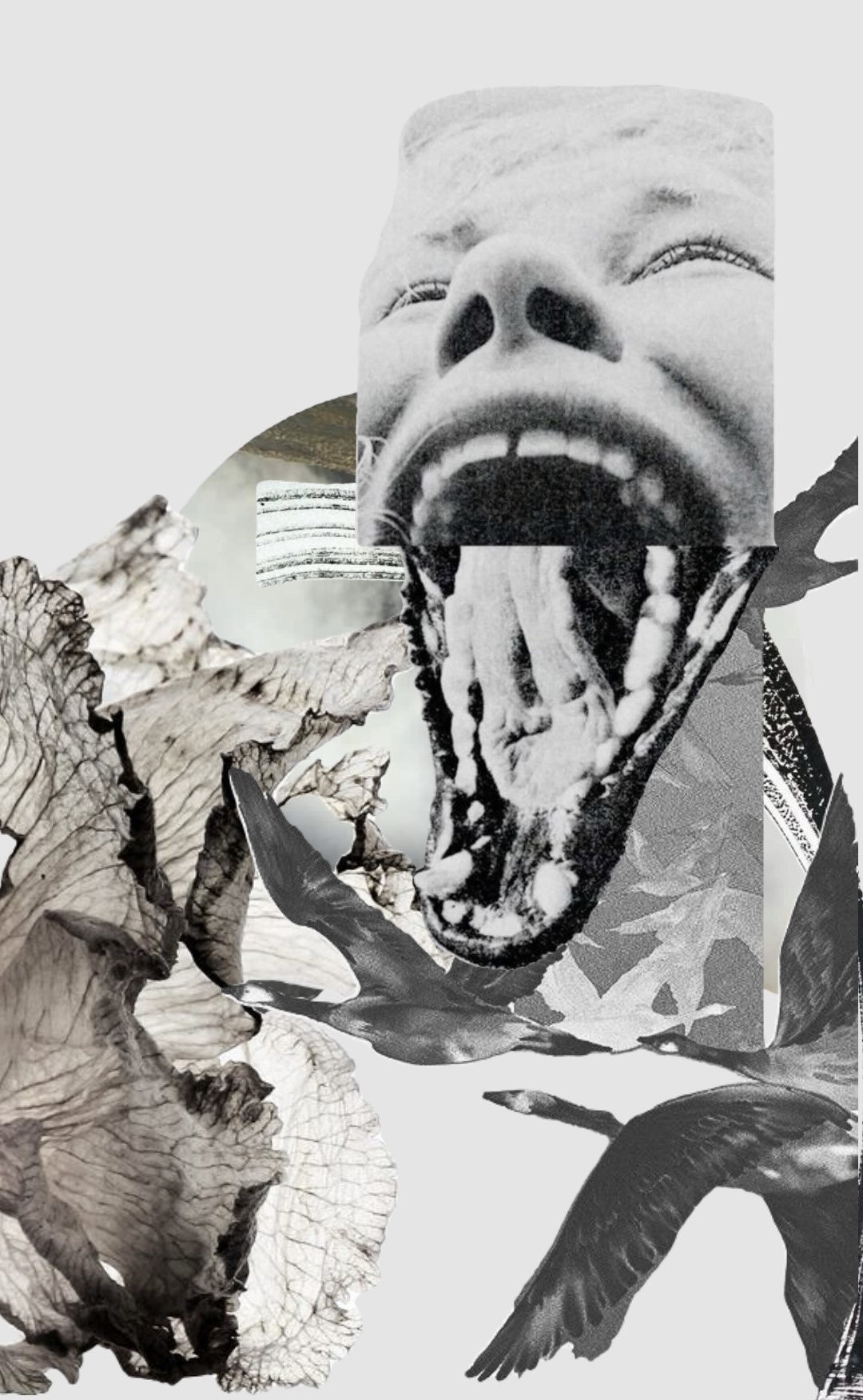
    The day the date the specific now is gone. The words in my mouth dissolve as a bucket of liquid anxiety drenches my upper body, primed for travel across tissue and organs, dripping leaking seeping from my ribcage onto my intestines. It slowly passes. When it does, I want to throw up in hopes the colors—glowing gradations, oscillating shades of pink that flicker red and glow pink again as the almostnausea fades—vacate the pit of my empty stomach. In a sweeping, crowning motion, an electrical current spreads from my scalp to my eyebrows. It makes me reach out for something to hold onto. Bracing myself, I close my eyes a moment. I can hear my heart beating. I can taste my heart in the back of my throat. Struggling like a baby bird fallen from its nest. Writhing in the cupped hands of a stranger. When I open my eyes again I see the outline of my feet under a hospital blanket. I see my wife, asleep in a chair, across the room. I look out the window and see a blue jay watching me, its feathers brushing the glass.


    Neurodivergent Seattle writer Jason M. Thornberry’s work appears in Route 7 Review, The Stranger, Adirondack Review, Hash Journal, Entropy, and elsewhere. His work examines disability, family, and social justice. An MFA candidate at Chapman University, Jason taught creative writing at Seattle Pacific University. He reads poetry for TAB Journal.

  • HABROMANIA by Nachi Keta

    Once there was a fisher. Poor. Lived in a humble shack by the ocean and always wore the same pair of loincloth and vest. People didn’t despise him, but they didn’t love him either. They saw him with a peculiar mixture of disgust and empathy, and kept an eye on him out of ennui. 

    His average day was simple. He would awake with the first ray, and after morning rituals, launch his boat into water. He’d catch fish till noon. After which, he would have lunch on the boat, the same— fish and rice. When the sun got too high, he would nap near a particular rock where the wind blew strongest and where the nosy visitors knew nothing. 

    Evenings would involve more fishing if he was in the mood. If he wasn’t, he’d go to the market and sell his stock. He would be off to bed before sunset. He had no ambitions and was content with what he had. He knew nothing of the outside world. An ignorant soul, he lived for himself, with himself, and never cared to grow in life. The concept of progress was alien to him. He dragged on with the same monotone— carefree but without utility. 

    He was never sad. But he was not happy either. He didn’t know what ‘happiness’ meant.


    In the ocean, near the fisher’s shack, was a colossal ship. Its owner was a prosperous entrepreneur. He had achieved everything— even though there was no limit— and perhaps that’s why he was never content. Not that he cared. He knew progress grew, but only on the thick skin of persistent dissatisfaction. 

    He was ambitious and liked to keep himself ahead of others. He would begin making drafts of his next project even before the present one’s culmination. That way he gave jobs to millions; he had contributed a lot to society. But something troubled him. 

    People called him their friend, but experience and intuition had taught him that most were faking. He could trust no one. His wife had already left because he couldn’t give her time. His children wouldn’t spend time with him as they were too busy with the objects he had bought for them. He couldn’t enjoy sugar because he was diabetic. He couldn’t enjoy salt because of hypertension. Deep inside, he was unhappy. 

    Though he was forced to smile in front of others, to show them he was tough, that he was enjoying what he had. He was deft at it. It was an art well practiced in his growing years, and over time, a mask had got pasted on his face— which would smother him. 

    In the interviews he would say that one must be honest; one should always speak the truth and work for the greater good. He was a role model for many. His meteoric rise from slums to riches was a folklore. But he himself knew what he had lost in that tremendous ascent. His inner self tormented him, for the many lies he had spoken, for the many acts of debauchery he had committed, even for a better cause of the greater good. He felt—deep inside—he wasn’t worth a penny. 

    Success comes at a price, and perhaps that price was his happiness.


    Working under the entrepreneur was a middle-aged man. Neither rich nor poor. He would come to work in time, juggle through the day, with periodic pauses of discussions on love, politics, religion and marriage and be off to home by evening. Then he would watch TV, talk with his spouse for a while, or do something he did whenever he felt unusual.  He was happy. Or as he thought. Or rather, as he forced himself to think. Man is clever. He does a marvelous job of fooling himself. 

    Once he was young and wanted to do great things; like the entrepreneur. But he was not ready to negotiate with his principles. And anyway, there were too many obligations. Sisters to marry, an ailing mother, a father who never approved. A wife, a house, bills, children’s education, weddings, funerals. 

    Throughout his life he was too engaged to give a thought on happiness or on its lack. But sometimes, in his hours of stillness, he would look at the fisher and think about living a carefree life. He would look at his boss and think about living a more affluent one. His own life had been a string of mundane events, which depended on the ones preceding them. 

    And yet, he had thought about his retirement. He would compose a novel, or open up a diner, and play with his grandchildren. It’s not that he didn’t want happiness. It’s just— it depended on a remote future which when it arrived, would turn into the present. 

    He was always about to be happy.


    Which of the three are you?


    A dropout of two of the most prestigious universities of India, Nachi Keta is a Kidney Transplant Recipient. He loves his privacy too much and pretends to be SAGE on Twitter (@KetaNachi).

  • ghost tour of penn hills honeymoon resort by Kailey Tedesco

    in last night’s dream i knowingly did awful. our love’s trauma

    snuffs the courtyard, salts it glass-stained—vegetation grows

    only to house the tongues of snakes, preening to bite. the old hotel

    encores its chant of honeymoon suites, all of them buzzing 

    decaywards. my own soul, askew, charms against what was once

    a mattress, now a trundle slipping with lip-whispers. there are sorry stories 

    in all the bathtubs where legs, not ours, once tangled rubbery. we sit in them 

    now, our own legs wet with shard-cuts perfect for re-reddening the carpets. 

    flies garland us pastural & we wear the best remains of night clothes recovered 

    from the wedding pool. this is the future we would never dream of 

    leaving. watch us appear tenfold in every broken mirror, all our old laughs 

    the dying out of auditorium chatter. there is nothing for us here. 

    this hellscape, our hellscape. we are so mundane at the threshold 

    of this cosmic tonsil sweetening to swallow its rightful hole of earth.  


    Kailey Tedesco is the author of She Used to be on a Milk Carton (April Gloaming Publishing), Lizzie, Speak, and FOREVERHAUS (both White Stag Publishing). She is a senior editor for Luna Luna Magazine, and she teaches literature and writing in Bethlehem, PA. You can find her work featured in Black Warrior Review, Fairy Tale Review, Gigantic Sequins, Passages North, The Journal, and more. For further information, please visit kaileytedesco.com. 

  • i can’t be by berkay bayram

    i can’t be.
    and i carry that magical burden of the fact that i can’t be.
    i can’t be the spectrum of colors that shows up after the rain, to be a good scene.
    i can’t be the sugar in the coffee that makes it taste sweet.
    i can’t be a gold key for my folks that feel locked up.
    i can’t be a couple of shoulders for those who need to lay their heads on.
    i can’t even be who i’d like to be, or where i’d like to be.
    i don’t know how to be so that i can be.
    i assume, i can’t be.
    maybe i shouldn’t be?
    maybe i’m not meant to be.
    maybe Shakespeare was a lying bastard who spoke bullshit about, to be.
    maybe it’s not about “to be or not to be,” maybe it’s about not to be, and how we cannot be.


    Berkay Bayram (he/they), 19-year-old writer, was born in Avsa Island, Turkey. Under the harsh political climate in the region, they are inspired by the queer-feminist solidarity. Their former works were published in Ample Remains, Dead Fern Press, & Poetically Magazine.

  • Poetry by Mckenzie Lee

    Measure Blue

    There are browning crescents,

    where I dug my nails into waxy mottled flesh.

    The moon is out with a rising sun- waning sharp,

    soapy pear and thumbprint smooth bark.

    There are many different kinds of cyanoscopes,

    holding the green up transforms what kind of sky it is.

    Arm up with branches- I notice-

    early frost or the dogs did it.

    White cat in a pear tree, rigor mortis.

    Not fit for a Christmas song.

    I bite into a death scene,

    measuring blues and greens and dull fur.

    Soft salt and French soap in a clawfoot tub,

    pears can decide what color blue you see.

    Eyes stuck open, early frost  


    Ankle Biter

     This dog will only drink from my Achilles tendon and

    I use a spoon and dig 

    every morning, 

    pouring it into one of those

    Maze bowls

     So

     he drinks it slower

    I am so thankful that this dog needs

    someone like me

    to live

                Dizzy, anemic

    His eyes were gold when he was born,

    so gold I smelled bitter almond,

    like in the beginning of  

    Love in the Time of Cholera

    The color of death isn’t black, it is

    a soft amused gold. 

    little bursts of

     blood.

    red now

    I can’t put it down I-

    I love this dog.

    through to the bone now

    There are many strong smells

                in the interim 

    Iron, almonds, and too warm dogs


    Sleep Paralysis List

    1. A cloud of failed stars showed me a door to eternity, inside were two sitting rooms and a showcase of Faberge eggs.

    2. Once a cat with no eyes wept by my bedside.

    3. A creature with a plate for a face and elongated arms would run at me whenever I turned my head toward the door.

    4. I am restrained by an invisible giant, chuckling in white noise, “I’m much bigger than you.”

    5. A witch laying down on my dresser top tells me that the dead don’t go anywhere. “They’re all still right here.”

    6. A being that is a shimmer in the air tells me with a burst of blinding light, “Do not look.” When I wake from that one, I google angels.

    7. I was told by the dead that remembering them traps them here.

    8. Spooned between two different forms of lightning, I said aloud to something in the dark, waiting to hear a truth-

    “There has never been a beginning.”

    I felt it kiss me cold after that, both of us smiling.


    Immurement

    I imagine us in our houses, clinging to our walls, 

    communing with

     a horse skull dreaming in clay foundation.

    Canopic jars purring under roses 

    in the wallpaper.

    We may bow ourselves into dumbwaiters and sleep.

    Curl up between two concretes ribs, in our grandmother’s houses

    with the beehive that’s holding good luck instead of honey.

    “Ah,”, my grandmother says,

    “That’s what all that humming was about.”

    When we are thirsty

    We will slide the light switch by the sink aside

    grab our favorite mugs

     turn the tap and drink lead

    The mice now living on our places on the sofa will be less alarmed at 

    disembodied arms then we would have been. 

    thousands of years from now,

     when mice archaeologists uncover us 

    cocooned in pink insulation foam, 

    they’ll claim that their ancestors put us there

    to ward off

     some kind of plague. 


    Mckenzie Lee lives in Minnesota where she explores writing, sleep paralysis, and the geography of dreams.

  • When My Feet Touched Dark Soil by Jessica Drake-Thomas

    When my feet touched dark soil,

    flowers sprang up. 

    Why does the sight 

    of meadowsweet

    make me sad?

    It reminds me of who I once was. 

    The power I had, 

    under the face of the sun. 

    When I fell, I did not fall alone,

    now I suffer in the dark, 

    my sadness, a bitter fruit,

    lodged in my throat. 


    Jessica Drake-Thomas is a poet, fiction writer, book reviewer, and PhD student. She’s the author of Burials, a gothic horror poetry collection. 

  • Poetry by Christy Chris

    We Are the Over Comers

    We have come
    From over the years
    Bearing sheaves of history
    History that was for us, a reality
    Reality, that remains more than a reality

    We have come
    From over the years
    Bearing memories
    And lines engraved on the templates of our memories
    Refusing to be washed by time’s heavy rains.

    We have come

    With irregular tattoos on our arms
    Carved with impatient tips of acrid swords
    From hands, too impatient to be schooled.

    We have come
    From the place where we gulped gallons of pain
    Sweetened with the ingredient of hopelessness

    We have come
    From dining with our enemies
    Where we ate the grains of sorrow
    Served in the bowl of shame

    Yet!

    Our eyes remained alive

    We refused the comfort of bending our knees
    And remained unbroken.
    As our hearts pounded insolently
    Under the thin shield of our black skin.

    We do not look like where we have been
    We do not look like where are coming from
    And we do not look like the battles we have fought
    We are the over comers. And today,
    With soles, firmly planted on the soil of freedom
    We gift you a better morrow
    Set on the sail of dawn.


    SPIRITS AND SHADOWS

    The birds have forgotten to fly

    And our shadows stand resolute

    Unwilling to go with the night


    Our children have long forgotten the language of laughter

    For the wax fluently in the dialect of tears


    Who will be the referee between 

    The hungry spirits and angry shadows

    For the sword must be drawn from its sheath 

    Or else, we become breathing corpses.


    Christy Chris is a young Nigerian poet and most of her works are deep expressions of the prevalent situation in her country and of life and the world at large. Her works depicts an unflinching and undaunting hope for change and growth. She hopes to touch and influence lives by her writings. Christ Chris was the winner of the Okigbo poetry competition (2014) and the winner of ‘Scribble the future’ (2016). She was also shortlisted as one of the 100 best young African poets in 2018.

    Her works are documented in her blog: abvnormal.wordpress.com

  • Eating Pears on the Rooftop by David Estringel

    Come!

    Let us eat green pears—

    cold—

    at night on the rooftop

    under burdened boughs of the old yew

    and the moon’s pale glow.

    Let us love 

    and laugh at myths and shadow-plays

    born of sticks and stones and celestial light—

    the stuff of illusion

    (delusion)

    that pulls us far from the cold comfort

    of home.

    There, the close confines of our rooms lie, prepared,

    untouched by the deceits of night and day–

    welcoming

    and pure.

    O, to be with you in the dark

    (boundlessness within those walls)

    behind thick curtains of rich brown and verdant green–

    that glorious place of undiscerning Truth,

    where glamours crumble to dust

    (to dust).

    To this

    we say, “Yes! Yes! Yes!”

    and kiss the silver—sticky and sweet–

    from each other’s lips,

    each soft brush 

    a rap on the front door.

    David Estringel is a ‘2019 Best of the Net’ and ‘2019 Over the Edge New Writer of the Year’ nominee, whose work has been accepted and/or published by littledeathlit, The Elixir Magazine, Soft Cartel, Digging through the Fat, Haiku Journal, Drunk Monkeys amongst others. He is also the author of three published chapbooks entitled, “Indelible Fingerprints,” (Alien Buddha Press), “Punctures,” (Really Serious Literature Disappearing Chapbook Series – #104) and “Peripheries,” (winner of the 2019 Bitchin’ Kitsch Chapbook Contest).

  • Some People by Ken Tomaro

    some people like to play it safe

    clinging to the banks of the river

    others float right down the middle

    and still others go where they want

    not paying attention to the rest


    Ken Tomaro is an artist and writer living in Cleveland, Ohio whose work has been published in several literary journals. He has also published three collections of poetry available on Amazon. His writing reflects an open, honest view of everyday mundane life living with depression.

  • I Am My Roots by Andrés Sánchez

    At first,

    I was from the motherland.

    Frijoles con queso y bolillo raised me.

    Corn tortillas kept me alive.

    I am from where the eagle perched on nopales.

    Green as the mountains the Aztecs called home.

    White as jicama con chile and limon.

    Red as the blood of my indegenous mothers.

    I came from maternal Abuelos raising me

    as their own for two years.

    From pan dulce that sweetened the days

    I mourned the absence of my parents.

    I came from el temblor del 85

    that shook all the fear out of me.

    From weekly shots recommended

    for my fragile anemic body at 4.

    From my first crush on the neighbor across the street.

    From the life on techos and macetas hanging

    in my grandmother’s jardin.

    I left custom-made baby clothes

    bought with my mother’s hard work en la tortilleria.

    For second-hand clothes given to my father by his coworkers.

    Traded homemade zopes for cheeseburgers

    made the American way.

    Santa Ana raised me for a few years.

    Taught me English, but my mother never let me forget

    my first language so I kept the Mexican accent

    cemented on my tongue.

    Tustin became my fourth and fifth home.

    Here, I quickly learned my differences when

    a White boy used a rock to split my head open.

    What are you? Where are you from?

    Became questions I could not answer.

    Even when I felt drips of blood from my wound.

    Cali kept my heart always.

    But I was raised in a city translated from “The Meadows.”

    Las Vegas blazing desert summers.

    The rays of the sun seeped deep into my skin.

    Each day browning more.

    Red rocks became my playground.

    I wore a cap and gown for the first time in my lineage.

    Repeated again 6 years later.

    Destiny called.

    I have never dug a hole deep enough to hold my roots in place.

    Until now, I’ve only encountered malnourished soil

    too soft to hold them down.

    My 18-year-old sister helped me drive

    my green Ford SUV back East near the Potomac River.

    Military base and Pentagon were my backyard.

    The Smithsonian offering free history at my fingertips.

    Again, hardly any history was mine.

    None of the apartments I lived in

    could hold enough of my sadness.

    So it overpoured into the streets.

    Made it to my work desk where I

    embraced my passion for health.

    I learned to travel.

    Took myself on road trips

    to escape the isolation.

    Got my first passport.

    Planned trips.

    Made a list of places I wanted to go,

    then packed my tiny car.

    Watched it get shipped back West.

    I arrived in the City of Angels on March 10, 2013.

    With a broken heart but more hope.

    I learned to become a Master.

    Cap and gown, now becoming a legacy.

    Unpacked years of trauma.

    Became my true self.

    Learned my way around the freeways and neighborhoods.

    Made significant friendships.

    I still struggle with calling any place home.

    Pack, unpack, repack, live out of boxes.

    Survive with the lessons from when this journey began.

    I am temporary.

    Like how my spirit lives in this body,

    temporary.

    I claim no hood.

    Like my ancestors,

    I settle where I can find a warm place to sleep

    and enough nourishment to guide me through this passage.

    I am not local.

    I am seeds in the wind leaving trees

    and flowers that eventually turn

    into beautiful fields near unplanned rest stops along the roads.

    I am of this world.

    I am from the earth.


    Andrés Sánchez (they/them/he/him), is a trans-masculine poet born in Mexico City, México in Ciudad Nezahualcoyotl. He migrated to the U.S. at the age of 5 and grew up in Southern California and Las Vegas, NV. Andrés moved to Los Angeles, California 6 years ago. It was here that he began to get involved with the poetry community. He has been featured in open mics such as East Side Queer Stories, Alivio Open Mic, The Back Door Reading Series, Influx Collective Reading Series, Tia Chucha’s Open Mic, Resilience for a Poetic Pandemic, One Mic, One Globe Open Mic, Pride Mic, Soapbox Poets Open Mic, and La Palabra. In October 2018, Andrés was accepted into the Community Literature Initiative Program, and became a participant in the 6th cohort of students to publish his finished work. You can find Andrés on Instagram as @this_poet_travels and as Andrés Sánchez on Facebook, where you can follow his poetry journey along with his travel adventures.

res·ur·rec·tion

/ˌrezəˈrekSH(ə)n/

the action or fact of resurrecting or being resurrected

raising from the dead

restoration to life

rising from the dead

return from the dead